臨床検査において、各種コレステロールの測定に利用されます。
| 由来 | Recombinant Escherichia coli |
|---|---|
| 系統名 | Cholesterol : oxygen oxidoreductase |
| EC 番号 | 1.1.3.6 |
| 反応式 | Cholesterol + O2 →→→ Cholest-4-en-3-one + H2O2 |
臨床検査において、各種コレステロールの測定に利用されます。
| 由来 | Recombinant Escherichia coli |
|---|---|
| 系統名 | Cholesterol : oxygen oxidoreductase |
| EC 番号 | 1.1.3.6 |
| 反応式 | Cholesterol + O2 →→→ Cholest-4-en-3-one + H2O2 |
| Appearance | Light yellow to yellow lyophilizate | |
|---|---|---|
| Activity | ≧ 10 U/mg | |
| Stabilizer | Sucrose | |
| Storage | below -20℃ |
| Molecular weight | ca. 57 kDa (SDS-PAGE) |
|---|---|
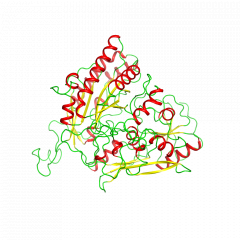
| Structure | monomer |
| Michaelis constant | 1.6×10⁻⁵ M (cholesterol) |
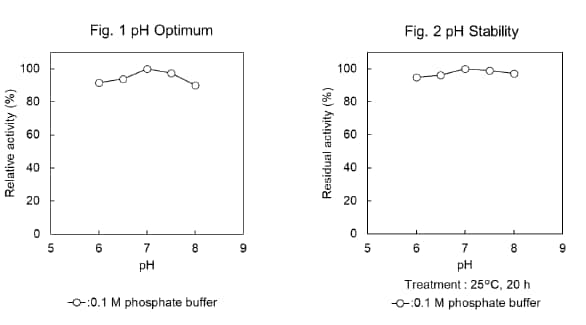
| pH Optimum | pH 6.0 – 8.0 (Fig. 1) |
| pH Stability | pH 6.0 – 8.0 (Fig. 2) |
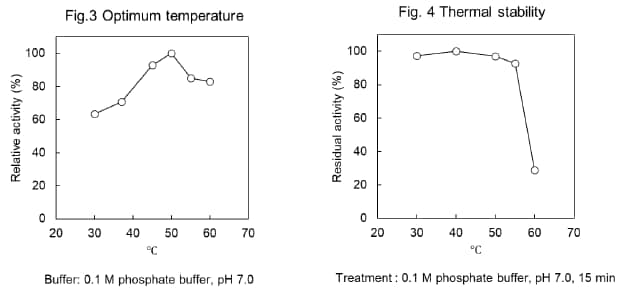
| Optimum temperature | 45 – 50°C (Fig. 3) |
| Thermal stability | below 55°C (Fig. 4) |
The enzyme is useful for the determination of cholesterol in clinical analysis.
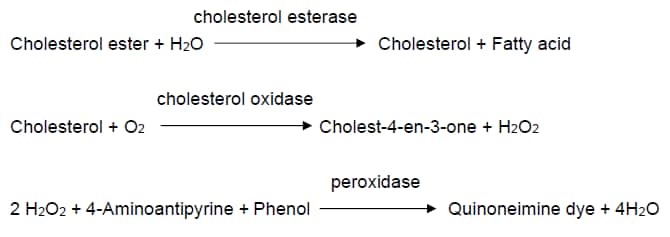
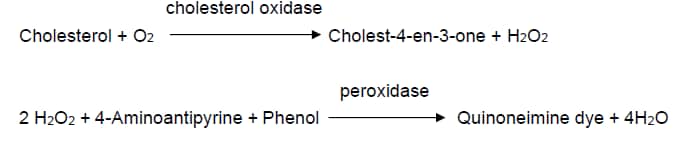
The appearance of quinoneimine dye is measured spectrophotometrically at 500 nm.
One unit (U) is defined as the amount of enzyme which produces 1 μmol of hydrogen peroxide per min at 37℃ and pH 7.0 under the conditions described below.
Sample: dissolve the lyophilized enzyme to a volume activity of 0.1–0.5 U/mL with ice-cold enzyme dilution buffer (Reagent F).
| 2.55 mL | Potassium phosphate buffer | (Reagent A) |
|---|---|---|
| 0.20 mL | Cholesterol solution | (Reagent B) |
| 0.05 mL | 4-AA solution | (Reagent C) |
| 0.10 mL | Phenol solution | (Reagent D) |
| 0.10 mL | POD solution | (Reagent E) |
Activity can be calculated by using the following formula:

13.8 : Millimolar extinction coefficient of quinoneimine dye under the assay conditions (cm2/μmol)
1/2 : Factor based on the fact that 1 mol of hydrogen peroxide produces 1/2 mol of quinoneimine dye
df : Dilution factor
C : Content of cholesterol oxidase preparation in sample (mg/mL)