Food Safety and Environmental Hygiene Monitoring System
Kikkoman offers a broad range of hygiene-related assay and detection instruments, including Rapid Hygiene Monitoring Systems and Microorganism Detection Systems. These devices operate based on chemical reactions between Luciferases, the enzyme that fireflies use to generate light, and ATP (adenosine triphosphate), which acts as a "proof of life" for all living organisms. With a focus on the keywords "Speed, Safety, and Simplicity," these products satisfy a wide range of needs for assuring food product safety.
Rapid Hygiene Monitoring Systems
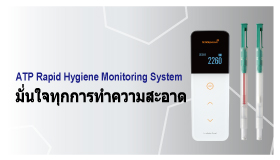
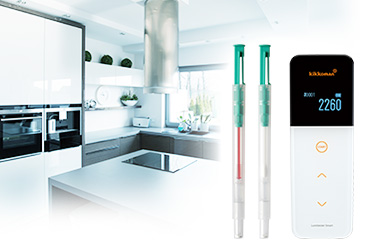
"Rapid Hygiene Monitoring" refers to testing employees' hands or food processing equipment and facilities to ensure that adequate cleanliness of contaminating is being maintained. These tests are extremely important in preventing cross-contamination, incidents which account for 60% of accidents in food manufacturing. Kikkoman's Rapid Hygiene Monitoring Systems use the ATP swab test method. The test area is wiped using the reagent kit LuciPac, which combines a reagent and self-contained swab device, after which light is emitted as a result of chemical reaction between luciferase-luciferin-PPDK reagent and ATP + AMP. The level of luminescence is measured using the LUMITESTER measuring instrument, and the degree of cleanliness is determined based on the amount of ATP and AMP detected. The degree of contamination is immediately shown as a numerical output, enabling a process of "check and take action" that is not possible using traditional culture methods, and thus allow accidents to be prevented before they occur.
Microorganism Detection
Microorganisms in foods tend to have a bad reputation, as a cause of spoilage or even food poisoning, but these microorganisms also play an important role in creating the unique taste of "miso" bean paste and other fermented food products. Kikkoman's Microorganism Detection Systems can measure both types of microorganisms, but in the case of food safety and environmental hygiene monitoring, the target is generally the former of these two types. Most food poisoning incidents are caused by "microorganisms"; food poisoning caused by chemical substances, such as the toxins found in blowfish or some mushrooms, account for less than 10% of the total. This is why Microorganism Detection is often equated with food safety and environmental hygiene monitoring. There are three main types of Microorganism Detection: Total viable cell count testing, aseptic testing, and biological indicator/pathogen testing.